
Introducing Formtoro v2
A new platform, built from scratch, Shopify-native and AI-native from the first line. Here's why we rebuilt Formtoro, and what it means for the way you collect and use customer data.
Back in 2020 we set out to build truly multi-step popup forms with live collection for Shopify — before anyone else had. We didn't grow as fast as we hoped, but we learned a lot. In the years since, tools like Klaviyo started shipping the same things we'd already built. Turns out we'd just been early.
A lot has changed since then. Shopify opened up its API, shipped native apps, and launched Sidekick. AI reshaped how software gets built and how marketing gets done. So we didn't patch the old product — we rebuilt it.
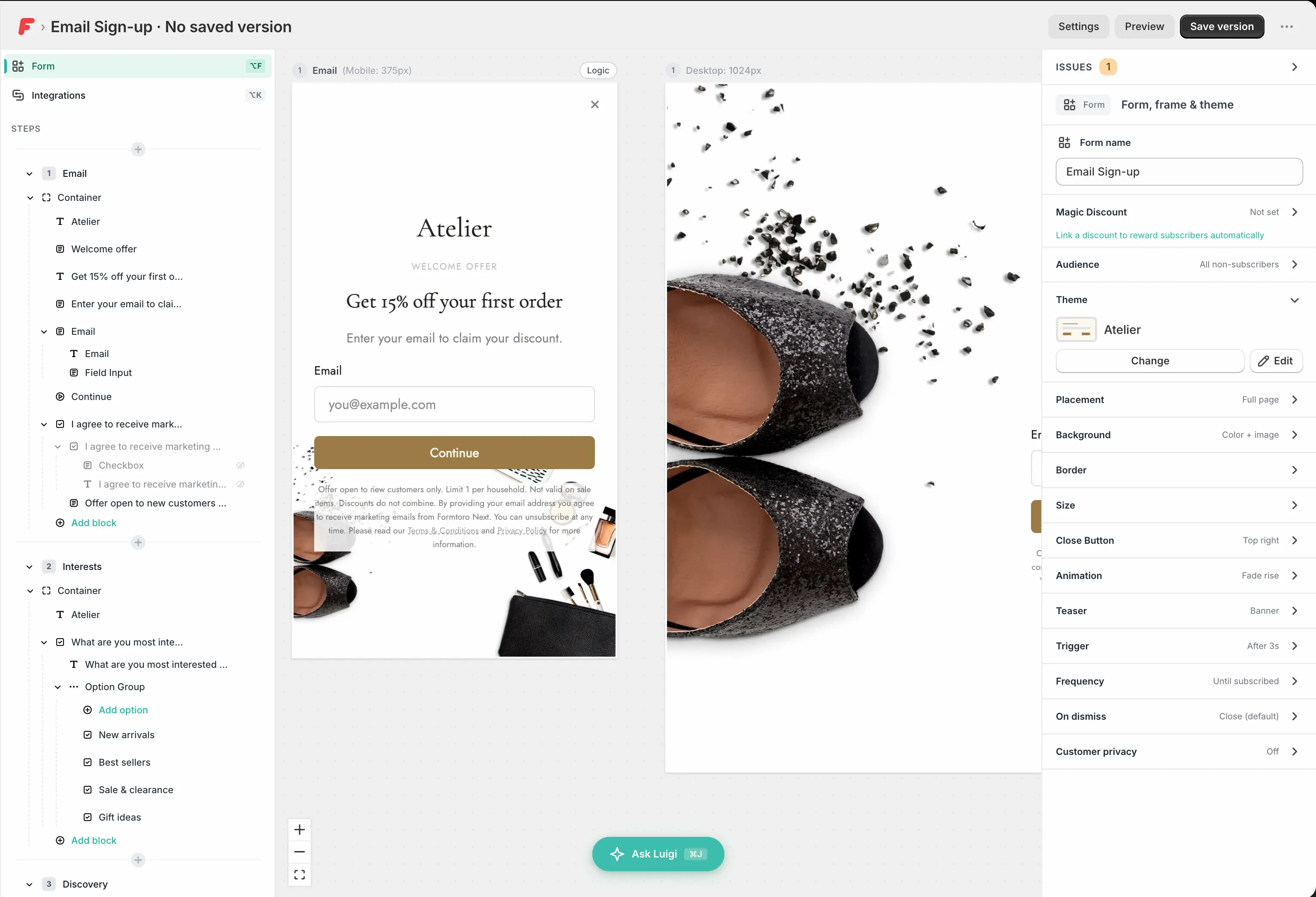
A platform, not a patch
Formtoro v2 is a brand-new platform, built from scratch, Shopify-native and AI-native from the first line. In short:
- Multi-step forms that branch on what shoppers tell you, so the next question is always the right one and you walk away with real buying intent on top of the email address.
- Magic discounts that apply themselves at checkout, with no code to remember, nothing to leak, and no margin lost to sharing.
- Fully native to Shopify: the discount is a Shopify Function, forms install from the theme editor, billing lands on your Shopify invoice, and Sidekick answers with our data.
- Mobile first, where mobile is the base and phones get their own behavior, not just a narrower layout.
- Luigi, an AI that builds and edits your forms and reads your store's purchase history in plain English.
- Attribution that closes the loop: submissions tied to Shopify orders, server-side events to Meta, and ROAS per campaign.
- A/B testing measured on revenue per visitor, not submission rate.
- An open stack: Klaviyo in two clicks, team roles, scoped API keys, and an MCP server that hands your own agents the same tools Luigi uses.
- Free to start, with paid plans from $79 a month.
What's new
We didn't just port the old feature set. v2 is built around the things that weren't possible, or weren't easy, six years ago.
Shopify Native
When we started, we wanted an app to be used across different e-commerce platforms. This time, we bet on Shopify.
We're a fully native app, and push the boundaries of what the Shopify API and platform can do.
The magic discount is a Shopify Function: Shopify runs it at checkout, and the reward sits on the shopper's own customer record. Forms install as a theme app extension, so a popup, inline embed, or launch button drops in from the theme editor with no script tag. Billing runs on Shopify's managed pricing, so we're on the invoice you already pay.
We answer back inside Shopify's own tools, too. Ask Sidekick about form revenue, subscribers, or ROAS by campaign and it uses ours to answer. Consent uses the Customer Privacy API, audiences read your Shopify segments, and insights come from ShopifyQL, which is why Luigi knows your AOV by referrer without a pixel.
Mobile First
Most of your shoppers are on a phone, so that's the screen v2 designs for first.
The builder previews three breakpoints (375, 768, 1024) and mobile is the base: what you set there applies everywhere until a wider screen overrides it, and every overridden property carries an indicator dot so you always know which value is doing the work.
Phones get their own behavior too, not just their own layout. A popup or slide-in defaults to a full-page takeover on mobile, a teaser can sit as a top banner on a phone and a corner bubble on desktop, and audiences can target device type outright. The details are in layout and responsive design.
Magic discounts
A magic discount is a reward with no code. The moment a form captures an accepted email or phone number, Formtoro grants the reward to that shopper on their Shopify customer record, and Shopify applies it at checkout on its own, often as early as the cart page. There's nothing to copy, nothing to remember, and nothing to leak onto a coupon site, because the reward belongs to a customer instead of to a code anyone can pass around.
Rewards live in a library: define one once, attach it to as many forms as you like. Percentage or fixed amount off, Buy X Get Y, free shipping, flat-rate or percentage-off shipping, or a single reward that grants a product discount and shipping together.
Targeting is precise, so you can pin a reward to one unit of the most expensive item and watch it stay there instead of spreading across the cart, scope it to specific products or collections, or restrict shipping by country, rate title, and maximum rate. If the restrictions leave nothing eligible, the shopper sees their normal rates rather than a half-applied discount. Static codes still work too, and they now apply themselves to the cart the moment someone subscribes.
The full breakdown is in the discounts guide.
Luigi, your AI builder
Tell Luigi what you want and he builds, edits, or fixes your form, without touching the parts you didn't ask about. He can also read your Shopify store's purchase history in plain English, so you can ask "what's my AOV by referrer?" and get an answer, no pixel or extra permissions required. Every new merchant gets a free AI grant, so Luigi works the moment you install. See everything Luigi can build for you.
Attribution and ad signals that close the loop
v2 ties every submission to downstream Shopify orders with a multi-touch model, and sends server-side Lead and Purchase events straight to Meta, with no browser-side guesswork. A new Ad Spend view joins your campaign spend to form-attributed revenue, so you can finally see ROAS per campaign.
A/B testing built in
Run A/B experiments on your forms the same way you test your ads: control versus variants, session-stable allocation, and revenue-per-visitor tracked per arm rather than a flat submission rate.
Integrations that respect your stack
Connect Klaviyo in two clicks with OAuth, with token refresh handled for you. Add your team with role-based permissions. The plumbing is built to be resilient: retries, idempotency, and durable status everywhere it matters.
An MCP server and real API keys
Luigi isn't the only thing that can drive Formtoro — you can too. v2 ships with a Model Context Protocol server and first-class API keys, so the same tools Luigi uses are open to your own agents.
Point Claude, Cursor, or any MCP client at your store and build forms, pull insights, and manage themes in plain language. Mint scoped keys from the dashboard, revoke them in one click, and every key action lands in your audit log. The full setup lives in the MCP server docs.
For the full, itemized list of everything in this release, see the v1.0 changelog.
Free to start
There's a free plan, and it's not a countdown timer. You can build real forms, collect real submissions, and connect Klaviyo without reaching for a credit card. The free AI grant means Luigi works from the first minute too, so you can see what v2 does before you decide to pay for anything.
And when you do grow into a paid plan, it costs a fraction of what v1 did. Our cheapest plan used to be $250 a month. v2's paid plans start at $79 a month, every paid plan comes with a 14-day free trial, and the limits are generous enough that you won't hit a wall in your first month.
We priced v2 to get out of your way, because a popup that stops collecting the moment it starts working isn't worth shipping. You shouldn't have to ration the thing that grows your list.
This is the start
Six years ago we bet that forms should be conversations and rewards should be effortless. v2 is that bet, rebuilt for the era of native Shopify apps and AI that does the work with you.
Install Formtoro, tell Luigi what you want, and watch your first form go live in minutes — your free AI grant is already waiting.